Trade-off Prioritization
Unlike feature prioritization (which orders user stories by value), trade-off prioritization answers a different question: when you can't have everything, which system attributes matter most to the customer and the team? Having these trade-offs prioritized and agreed upon makes it possible to determine which features take priority based on the value they contribute to the most important trade-offs.
What it's for
It fosters an open, collaborative dialogue about the product's attributes before design or implementation decisions implicitly lock them in. When trade-offs are not explicitly prioritized, each team member assumes their own priorities, and decisions are made based on inconsistent criteria.
It is especially useful during an inception or at the start of a new project, when the team and the customer are still unclear about the balance between competing attributes.
Running order
The technique is carried out as a team using a board and sticky notes:
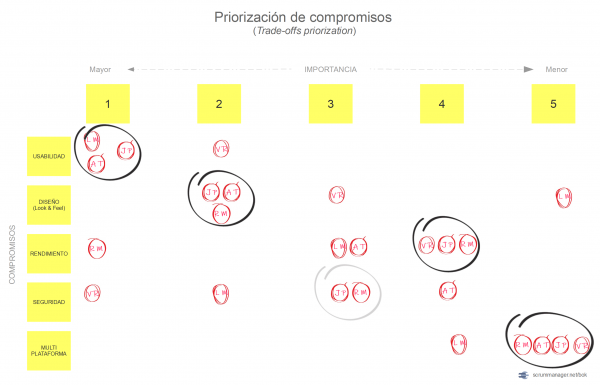
- The product's relevant characteristics or trade-offs are written on sticky notes: scalability, simplicity, security, usability, availability, performance, etc.
- The trade-offs are placed vertically, on the left side of the board. Each trade-off is the title of a row.
- At the top, a horizontal row of numbers from 1 to the number of trade-offs is placed. Number 1 represents the highest importance.
- Each member scores individually each trade-off by writing their name or initials in the column of the number that reflects their judgement of its importance.
- A person cannot give the same priority level to more than one trade-off: they cannot put their name twice in the same column.
- At the end, the column with the most names in each row reflects the collective importance level of each trade-off.
Common mistake
Prioritizing trade-offs only once and never reviewing it. The most important trade-offs may change as the product evolves or the market shifts. An attribute that was secondary at first (such as scalability, if the product had few users) can become critical later on. It is advisable to revisit trade-off prioritization during the early stages of the product or whenever business conditions change significantly.
Resources
📄 Agile Inception, ¿en qué consiste? [Agile Inception: What Is It About? (in Spanish)]Scrum Manager Blog · Feb 2023
See also
Want to advance in agility? You can search for course and exam calls or go at your own pace by becoming a member of the Agile Club. This membership includes exclusive resources, e-learning classrooms, and access to Skill Arena: a space to practice and measure your agile skills at your own pace.