
translate Automatic translation · View original
AI Doesn't Retire Scrum: It Makes It Essential

A question that comes up more and more
With AI already part of day-to-day work, many professionals, and many organizations, ask a logical question: if AI produces so much, so fast, does it still make sense to train in agility?
The reality of teams answers clearly. The 2025 DORA study, with about 5,000 software professionals, found AI use at 90%. Its conclusion was not that AI makes methods obsolete, but the opposite: AI is an amplifier. It boosts teams that work well and worsens the problems of those that don't.
Put another way: AI doesn't replace the way you work. It multiplies it.
Producing is no longer the problem
A marketing team asks AI for proposals for a campaign. By mid-afternoon they have twenty. The next day, nobody knows which ones fit the brand, which promise things the product can't deliver, or which will actually work.
Producing took an afternoon. Deciding, reviewing, and validating will take much longer.
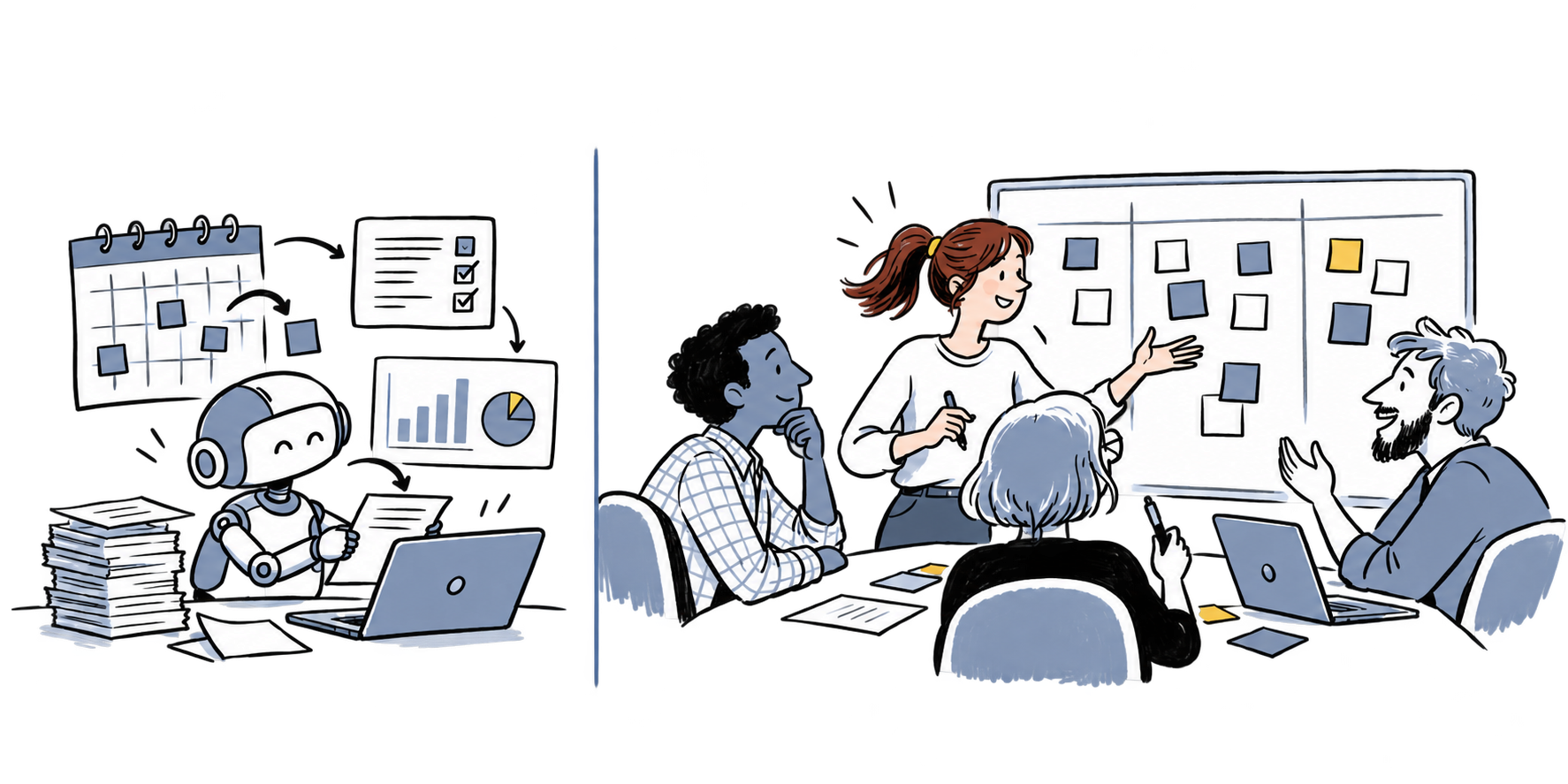
That is the big change AI brings to teams, and it is not technological. The bottleneck has moved: it is no longer in doing, but in deciding what deserves to be done, reviewing what was produced, and checking that it solves a real problem. Exactly what Scrum has been managing for more than twenty years.
More capacity is not more value
Let's be clear: AI provides real capacity. A team working with it can take on in days what used to take weeks.
For any team, the question is what it does with that capacity. Producing more is not the same as delivering more value, and the feeling of progress can be deceptive: it is easy to confuse the volume of output with the value of what actually arrives.
Turning that capacity into value, and not just volume, is exactly what agility knows how to do. Small increments that reach those who will use them soon, clear criteria for what is done, and decisions based on results rather than impressions. AI provides the capacity. Agility turns it into value.
Six insights that change the conversation
What teams working with AI are learning, sometimes the hard way:
- AI amplifies your way of working. For better and for worse.
- Producing is no longer the hard part. Reviewing, validating, and deciding are.
- Reviewing is also work. If it isn't planned, it becomes an invisible bottleneck.
- Generated doesn't mean done. With AI, the bar for "done" goes up, not down.
- Going faster is not being more agile. Measure results, not volume.
- AI proposes. People decide and answer for it. "The AI did it" is not an answer.
And a seventh, which is almost a warning: teams where AI doesn't work out tend to share something. They stop inspecting. They push up output, drop the retrospective to go faster, and lose sight of problems until an incident brings them to light. With AI, the retrospective is more necessary than ever.
And the Scrum Master?
AI already prepares agendas, summarizes meetings, and analyzes metrics. If that were the value of a Scrum Master, there would be reason to worry.
But the heart of the craft lies elsewhere: reading the state of a team, creating psychological safety, supporting people through change that brings uncertainty. Add to that new areas: facilitating work between people and AI, agreeing on how it is used and within what limits, safeguarding quality against work that only looks finished, and making sure those who are just starting keep learning the craft.
The Scrum Master doesn't disappear. The craft grows.
Now available: Scrum for teams working with AI
Scrum Manager has updated the Scrum Master guide. Version 5.0 integrates AI throughout the syllabus, so that working with it amplifies value rather than noise:
- what changes in each role, artifact, and event when the team works with AI;
- a new section on the Scrum Master's craft in teams with AI;
- examples from software and also from marketing, human resources, legal advice, education, or operations;
- no need to code or use specific tools.
The guide can be downloaded for free, in Spanish and in English, and it is the syllabus for the Scrum Master certification from Scrum Manager, which can be obtained through any center or agent in the network in two formats: Scrum Master, to lead the work system of a team using AI, and Scrum Master + AI, which adds the AI skill applied to agile work so you can work with it with sound judgment. Everything is available at Scrum Master in the AI Era.
The question is no longer whether Scrum will survive AI. It is whether your team is ready for AI to amplify the best of it.