
The best of the agile community
November 2026
Issue 09 · Specialized Periodical
"A selection of best practices and trends for agile leaders in the era of accelerated digital transformation."
AI Doesn't Retire Scrum: It Makes It Essential
AI has changed how almost every team works. What it hasn't done is make agility less relevant: teams working with AI have never needed it more.

1 October 2026
Featured Articles

Rereading the Agile Manifesto now that AI "does everything"
AI can propose and build, but if we let it also decide what we do, we are handing it the baton. In 2001, seventeen professionals gathered at a ski resort and wrote four statements that changed the way we work, because they moved the baton from processes to people. With AI we are losing it again, and if we want teams where talent and direction are human, the Agile Manifesto is more relevant than ever. Agility seemed to be synonymous with speed: more deliveries in short sprints. Now that speed comes standard, when an afternoon produces what used to take weeks, what agility really is becomes clear: learning early, deciding with judgment, and not losing sight of people. AI has not displaced the Agile Manifesto. It has taken away its excuses. After a year of incorporating AI into product management and development, I am seeing that the more power AI gains, which happens every month, the more necessary the principles that seemed outdated become.
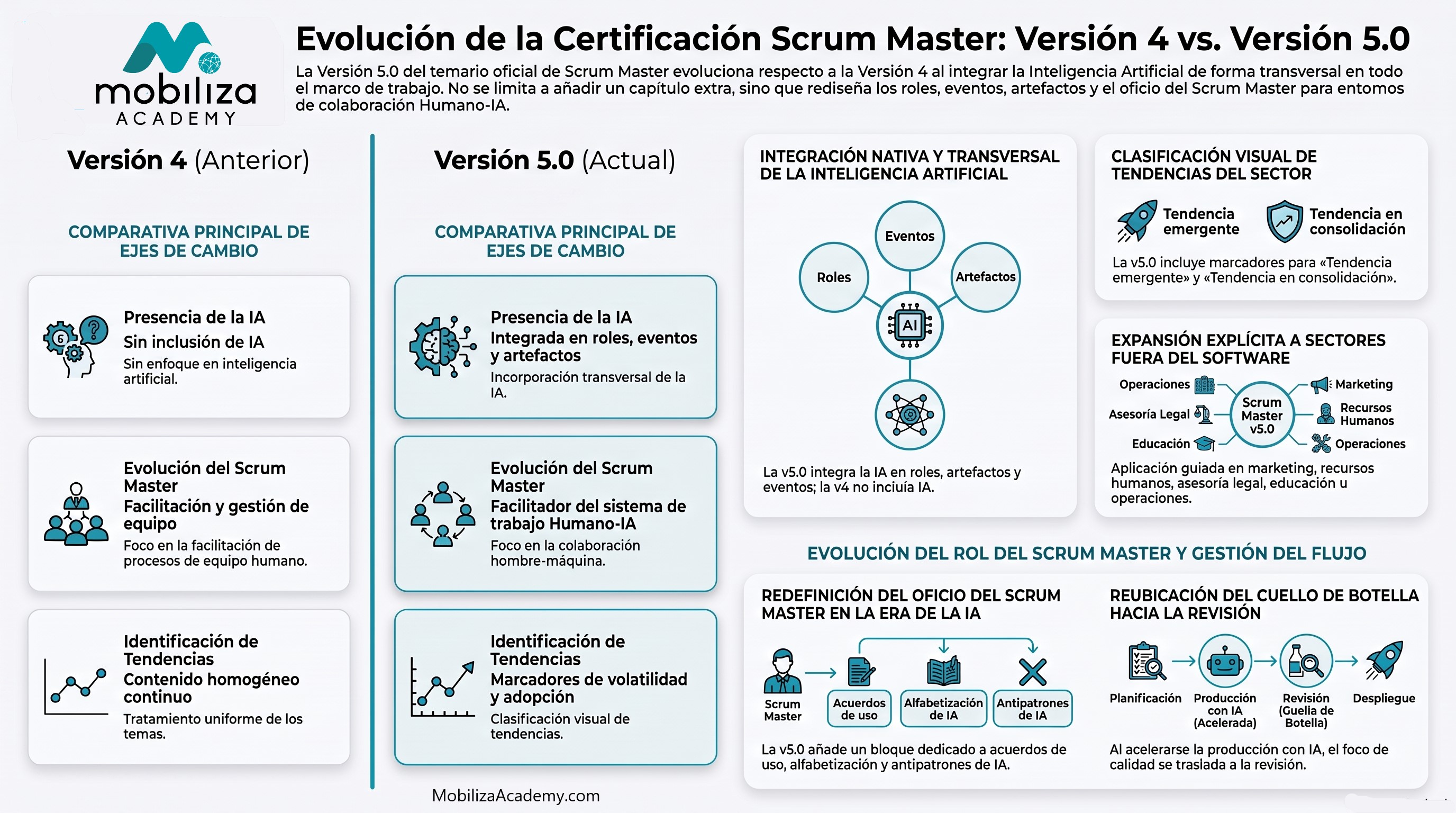
Evolution of the Scrum Master Certification at Scrum Manager®️
**AI accelerates production.** But I am increasingly clear that the real challenge is no longer there. When analyzing the evolution of the Scrum Master in the age of AI, there is one idea I keep seeing reflected in teams and organizations: **when producing becomes easier, deciding becomes harder.** Today we can generate code, documents, analyses, or proposals at a speed that seemed impossible just a few years ago. But generating is not deciding. And generating does not necessarily create value either.
Scrum Master 5.0: new certification update on Skill Arena
Artificial intelligence has changed what it costs to produce, but not what it takes to work well as a team. On Skill Arena we are publishing the update to the "Scrum Master" certification with version 5.0 of its syllabus, dated October 2026. It integrates AI throughout the learning path, as a team capability under human responsibility, and adds a third part devoted to the craft of the Scrum Master in teams that work with AI.

"You're One to Talk": How Whataboutism Shuts Down Feedback in Your Retrospectives
In the retrospective, someone brings up the valuable point that "I don't think we're testing enough before deploying." The reply doesn't address the idea: "And what about you, who never update the board?" The criticism is left hanging, the team gets caught up in egos, and the original problem remains untouched. It's a tactic as old as rhetoric (very common in childhood), and it has a quiet way of emptying our conversations. Let's talk about why it appears, what it does to a team, and what we can do about it.

The Product Owner in the "Age of Orchestration": Does AI Replace the Role or Transform It?
The term "AI Product Owner" has gone from nowhere to appearing in hundreds of job listings in barely a year, and with it has returned a question that resurfaces with every technological wave: is AI coming to replace the Product Owner or to transform them? The industry conversation swings between two unhelpful extremes: the panic of those who fear becoming obsolete and the enthusiasm of those who promise that AI will do the work for us. Neither describes well what is actually happening.

Does your company measure developer productivity? What does it really measure?
Almost every organization wants to know whether its development teams are productive, and many believe they already measure it. They count story points, closed tickets, lines of code, hours worked. The interesting question is not whether those figures are collected, but what they actually measure. Because more often than not, what looks like a measure of productivity is, on closer inspection, a measure of activity, and the two are not the same. Confusing them is not a technical detail: it changes how teams behave, and almost never for the better.

AI Applied to Agile Work: New Version of the Skill in Skill Arena
The foundations for working with artificial intelligence have settled, and what is moving now is what surrounds them: agents that execute work, standards that organize the ecosystem, and rules that change on schedule. We are publishing the October 2026 version of the skill "AI Applied to Agile Work," with a renewed State of the Art and guide. It incorporates the team's AI use policy, treats the agentic ecosystem standards as consolidated, and corrects the calendar of the EU AI Act, which was postponed in July.

In which aspect of agility do you think your team overestimates itself the most?
Ask any team whether it is agile and it will almost always say yes, and with conviction. We run sprints, we hold Daily Scrums, we hold retrospectives, the board is full. The sense of mastery is high. Yet when you look closely at how the team actually works, notable gaps appear between what the team believes it does and what it really does. That distance between perceived agility and actual agility is one of the most silent obstacles to improvement, precisely because those who suffer from it cannot see it.

When did you discover that what you thought the user wanted was something else?
Almost everyone who works in product keeps a similar story. We were convinced we knew what the user wanted. We had heard it in a meeting, read it in a survey, or taken it for granted. We built exactly that, carefully, and when it reached people's hands we discovered that what they really needed was something else. It wasn't an execution failure. It was a failure of listening, or rather of interpretation.

Does the "Spotify model" exist?
Few ideas have traveled so far and so fast in the world of agility as the so-called "Spotify model." Squads, tribes, chapters, and guilds have become everyday vocabulary in departments that have never had anything to do with music streaming. The scene repeats itself: a company decides to "organize like Spotify," redraws its org chart with the new jargon, and expects autonomy and innovation to arrive on their own. That rarely happens.