Frequent questions - Academic certifications
The Scrum Manager academic certification framework identifies the knowledge areas in which an individual has received training or holds recognized professional experience, represented through academic or professional credentials.
These credentials are complemented by SPs (Skill Points), which indicate the holder’s level of knowledge and its maintenance over time. SPs increase through training or active professional practice.
Academic certifications are divided into:
-
Core certifications: Scrum Master, *Advanced Scrum Master, and AgiLevel.
-
Extension certifications: accredited activities validated by Scrum Manager that extend or complement core learning.
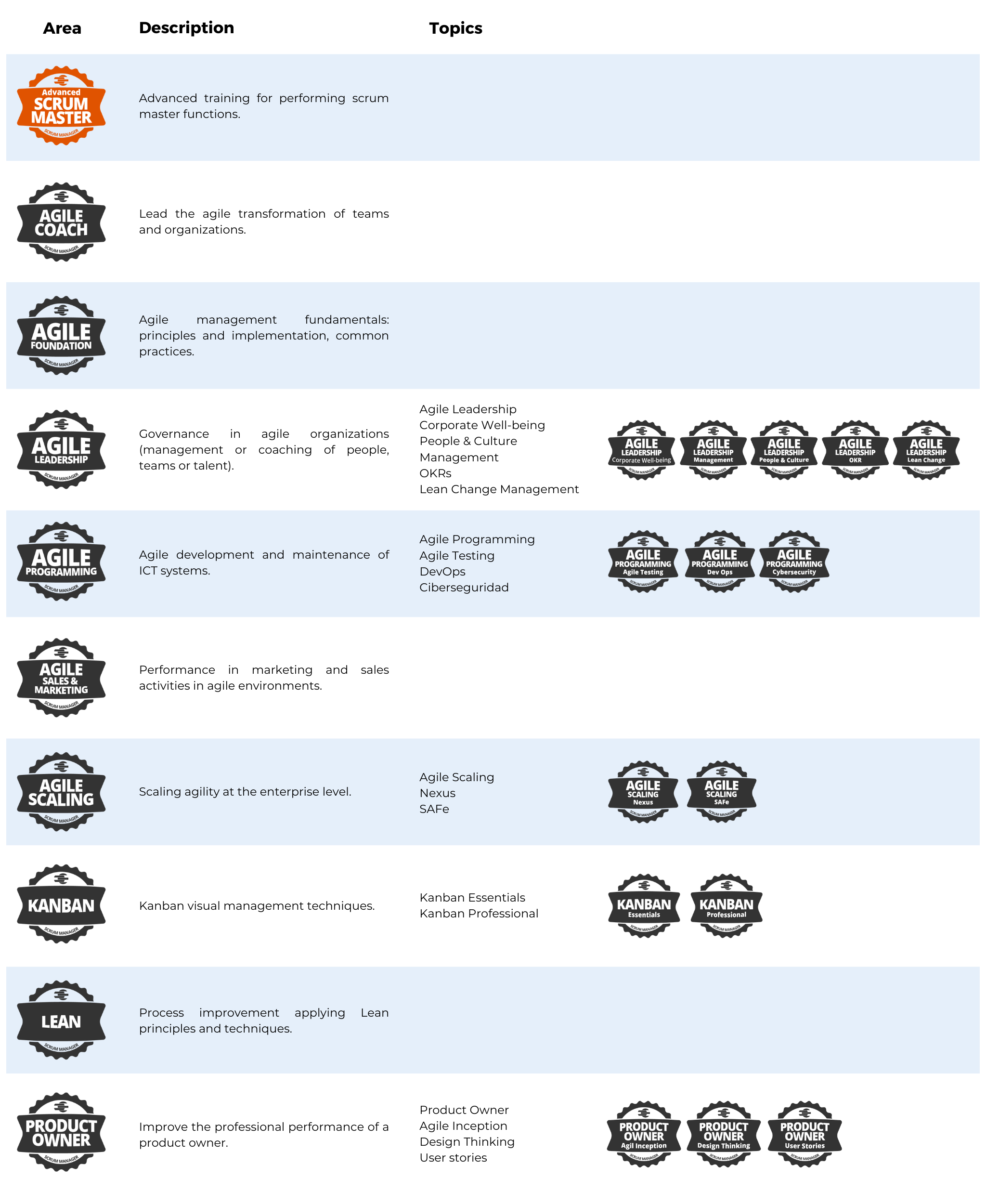
* Advanced Scrum Master includes training activities designed by trusted centers to provide continuity to the Scrum Master core without following a single syllabus.
More information at "Academic certifications".
To obtain an academic certification, you must take the corresponding course or exam through an authorized Scrum Manager center.
You can find available centers and sessions in the directory of centers.
More information at "Academic certifications".
The Agile Coaching academic certification is acquired passing the specific Agile Coaching course of an approved Scrum Manager center; or acquiring the Agile Coach professional certification.
Skill Points, or SPs, indicate whether the credential holder continues learning or applying agile knowledge in practice.
After the first year, SPs decrease by 20% annually unless renewed through training or active professional work (see "How to maintain or add SPs".
According to accumulated SPs, there are three academic levels:
-
Technician < 100 SPs. It accredits the knowledge to carry out a professional performance in projects managed in a scrum framework.
-
Expert < 200 SPs. It accredits additional knowledge of flexibility in implementation and working with agile practices.
-
Authority => 200 SPs. It accredits advanced and specialized knowledge in agile management practices and frameworks proportional to the certified degree.
The maximum level of SPs visible on each user's personal profile is 350. If more are obtained, the system marks 350+.
More information at "Skill Points".
Knowledge in agility evolves constantly, which is why it's important to keep your competencies up to date:
- Get certified with a center. You can obtain core and/or complementary certifications through official training centers.
- Join the Agile Club. Access resources and community to continue updating your training. Additionally, as a club member you will be able to:
- Validate complementary training in agile management (courses and activities without Scrum Manager certification).
- Validate your professional performance in agile management of projects, teams, or organizations. This contributes 40 SPs annually.
More information at "Skill Points" and "Agile Club".
The highest visible level on the user profile is 350+ PDAs.
Although the system can record up to 400 PDAs, the public scale ends at 350 to maintain a consistent professional categorization.
This approach ensures that the highest level remains visible even if PDAs gradually decrease due to the annual knowledge decay process (10%–20%).
More information at "Skill Points".
The speed at which knowledge evolves quickly outpaces the knowledge acquired. The Scrum Manager academic certification reflects this reality with a 20% annual decrease in Skill Points (SPs).
For example, a certification with 100 PDAs remains valid for the first year, then updates to 80 PDAs the following year, and continues decreasing annually.
More information at "Skill Points (SPs)".
It depends on the type of certification:
-
Academic certifications do not expire. They represent an educational achievement obtained after completing a specific training or assessment. However, the associated SPs decrease by 20% annually after the first year to reflect the need for knowledge renewal. They can be maintained or increased through training or professional practice (see "How to renew SPs").
-
Professional certifications must be renewed annually. To do so, the holder must request renewal through their personal area and maintain a high recognition rating (average >8).
More information at:
Academic and professional certifications serve different purposes and therefore have different renewal requirements.
-
Academic certifications (orange and black badges) are granted upon completion of a course or assessment and do not expire, as they represent a specific educational achievement at a given point in time.
-
Professional certifications (blue badges) indicate active professional practice in an agile role. To remain valid, they must be renewed annually, confirming that the holder continues to work in the profession.
More information at "Academic certifications".
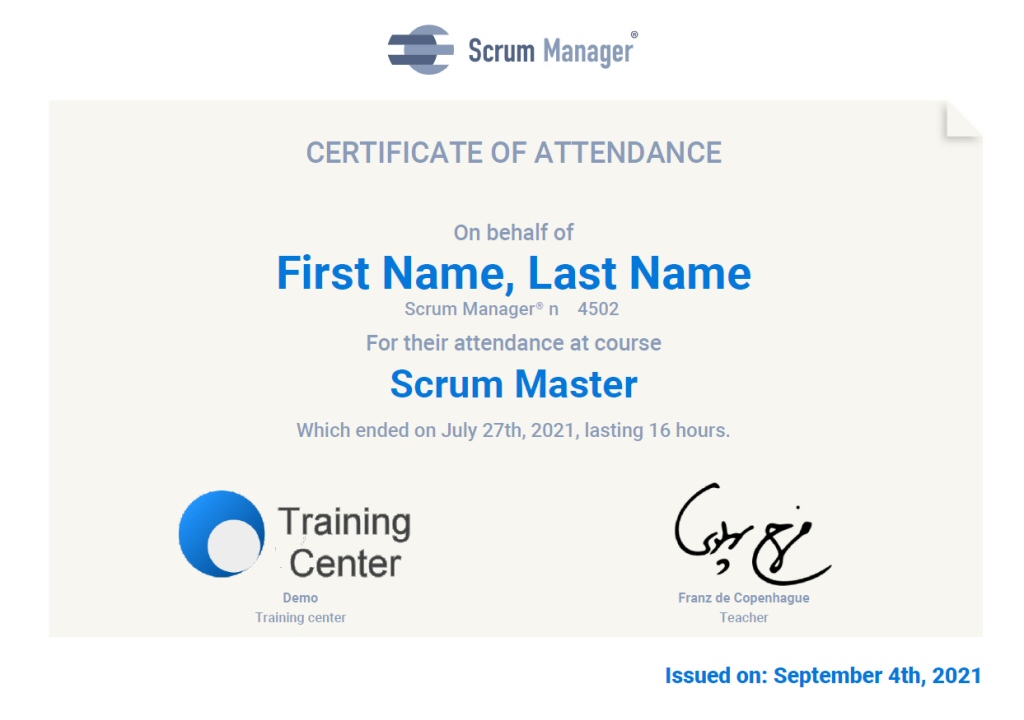
Of courses and exams*
Diploma of attendance
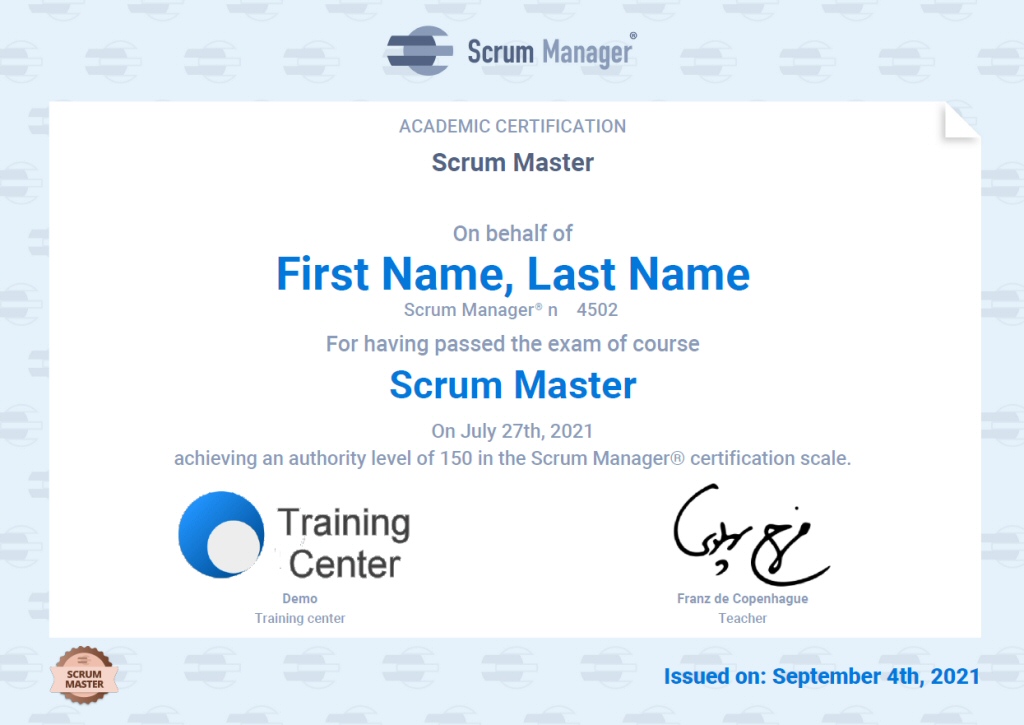
Academic certification diploma
This type of diploma corresponds to tests in which the identity of the student is verified and the completion of the exam or evaluation activities is supervised in person or by videoconference.
Complete information
General certificate
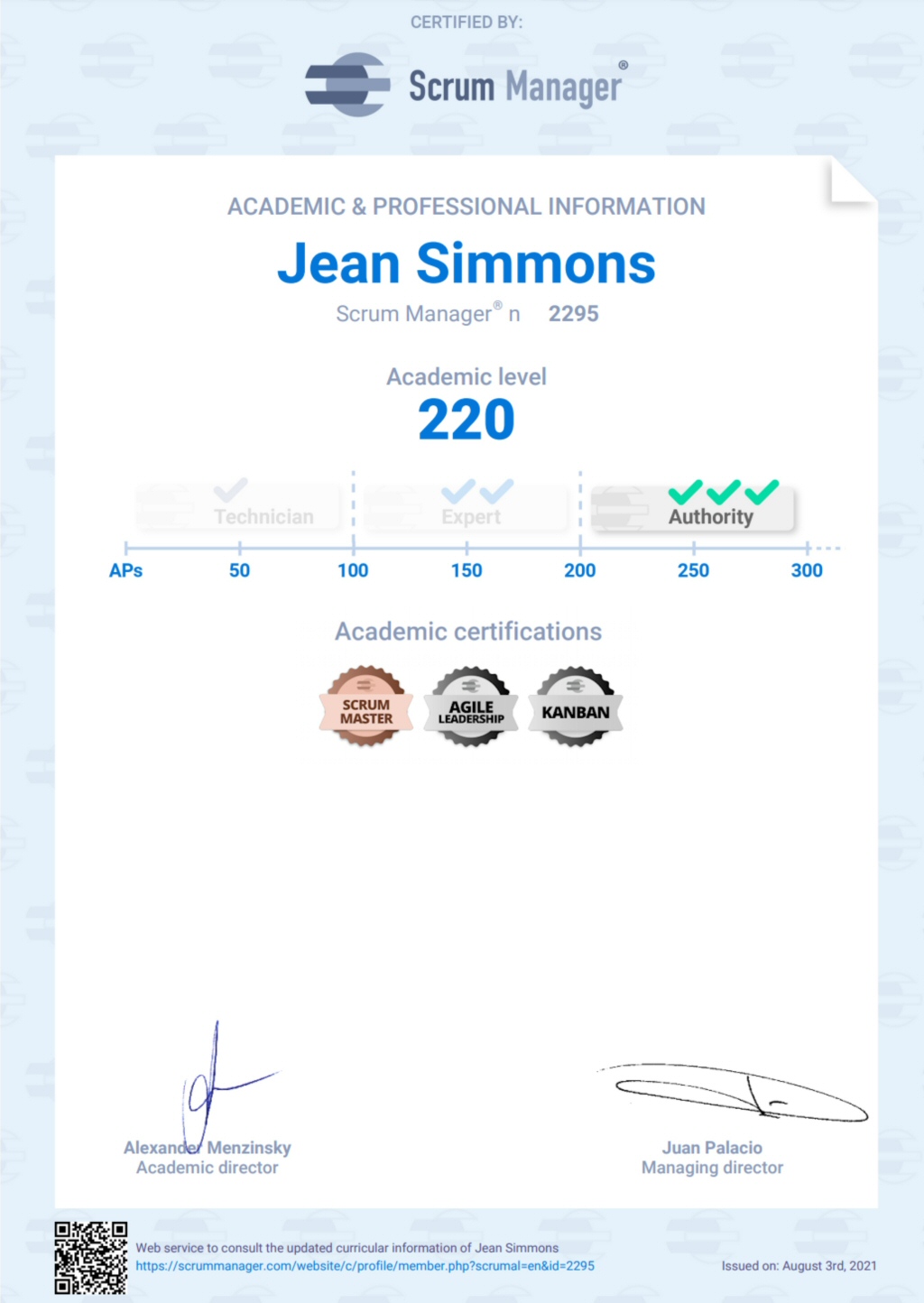
Grades certificate
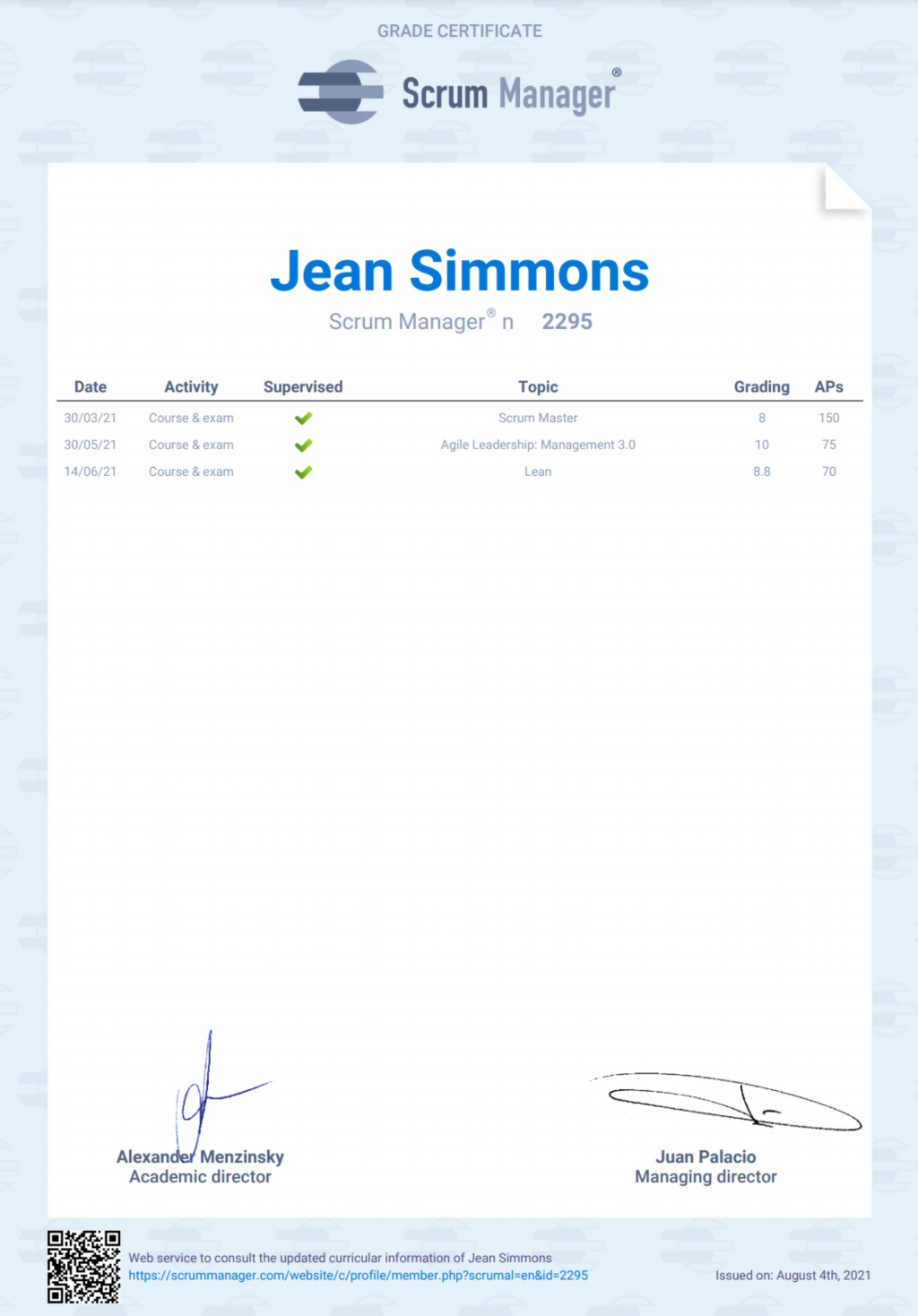
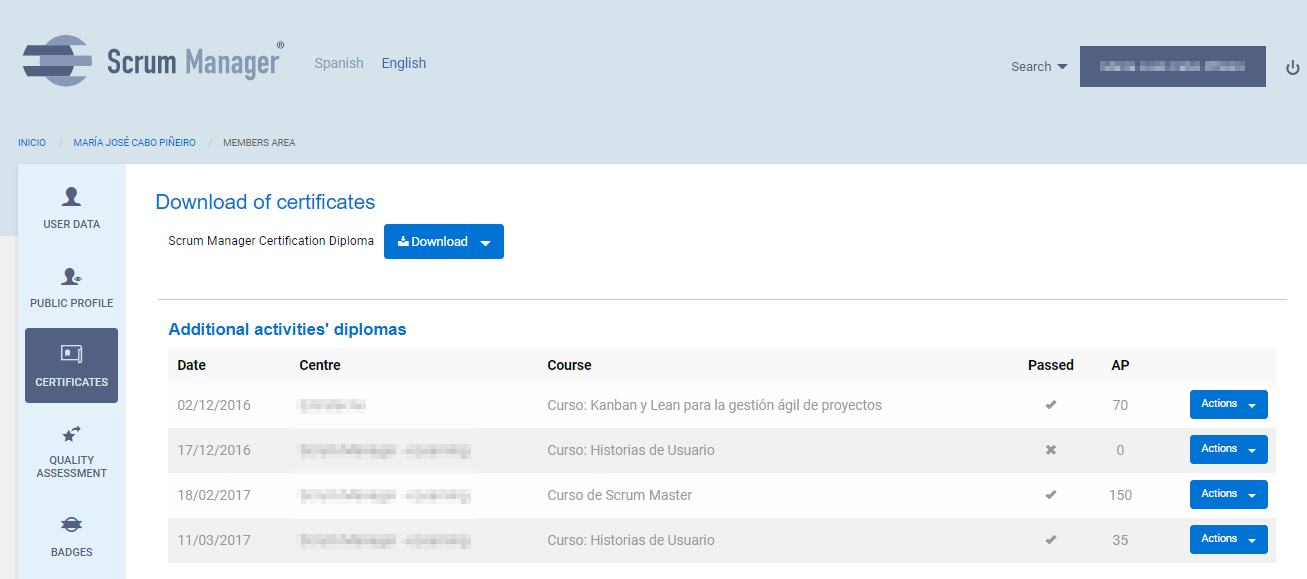
No. Accreditations are no longer available.
They were online, unsupervised exams completed without identity verification.
To ensure transparency, Scrum Manager now issues only official certifications, obtained through supervised exams that verify the student’s identity. These certificates can be earned through authorized Scrum Manager centers.
More information at "Academic certifications".

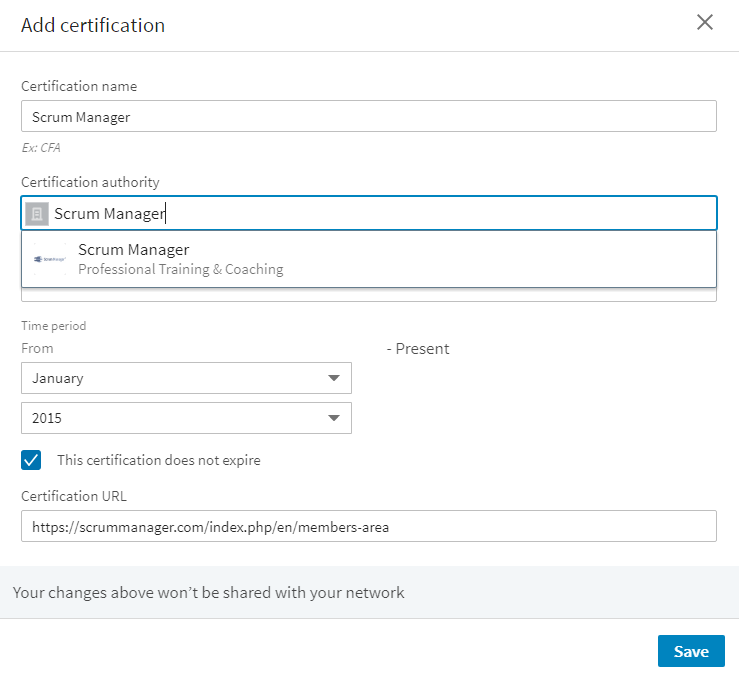
Select "Add certification" when editing your profile and enter the following information:
- Certification name: Scrum Manager.
- Certification authority: Scrum Manager.
- License number: the number on your certificate.
Scrum Manager’s certification keeps the amount of Skill Points and certified fields of knowledge for each student updated on their professional profile. Keeping this in mind, enter the following information on the remaining fields:
- Time period: from your registration date on Scrum Manager.
- Mark “This certification does not expire".
- Certification URL: URL of your professional profile at scrummanager.com.
Both exams are multiple-choice tests:
-
Scrum Master: 55 questions, 60 minutes.
-
AgiLevel: 30 questions, 45 minutes.
To take the official exam, you must attend an authorized Scrum Manager center.
Use the center directory to filter by country, activity type (course + exam or exam only), delivery mode (in-person or online with web supervision), and language.
How can I prepare for the exams?
You can prepare for the exam before getting certified. There are two ways to do it:
-
Training questions. They can be found within your user profile → "Academic certifications" → "If you are going to take or renew the validity of a core certification, you can practice training questions by clicking here."
-
In the e-learning classrooms available with the Agile Club suscription.
In both cases:
-
The exams accessed are created from the same question bank as the official certification exams.
-
The test is not supervised, and therefore no certificate is awarded; for that, it is necessary to go to an official center.
Professional skills are specialized accreditations that validate a professional's practical competence and expertise in specific areas of agile performance.
Unlike core certifications (Scrum Master or AgiLevel), which accredit knowledge of frameworks and establish the methodological foundation, professional skills focus on professional proficiency: they certify that you know how to apply specific tools, techniques, or strategies in real work situations.
What's the difference?
- Core certification (knowing): accredits your overall understanding of agile management (e.g., roles, events, principles).
- Professional skill (know-how): accredits your specialization and execution capability in a specific topic.
What professional skills exist?
The skills catalog is dynamic and grows continuously to adapt to new market needs (such as AI, Discovery, etc.). You can check the updated list of available specialties on the Skill Arena platform.
How are they obtained?
You can obtain a professional skill diploma through two pathways:
- Accredited training: by completing a specific course at a center accredited by Scrum Manager that includes that skill in its curriculum (academic diploma).
- Skill Arena assessment: by passing the level tests and simulators on our Skill Arena training platform (assessment diploma).
Note: the former accreditations known as "skill tags" have evolved and been replaced by these professional skills diplomas, which offer greater curricular and academic recognition.