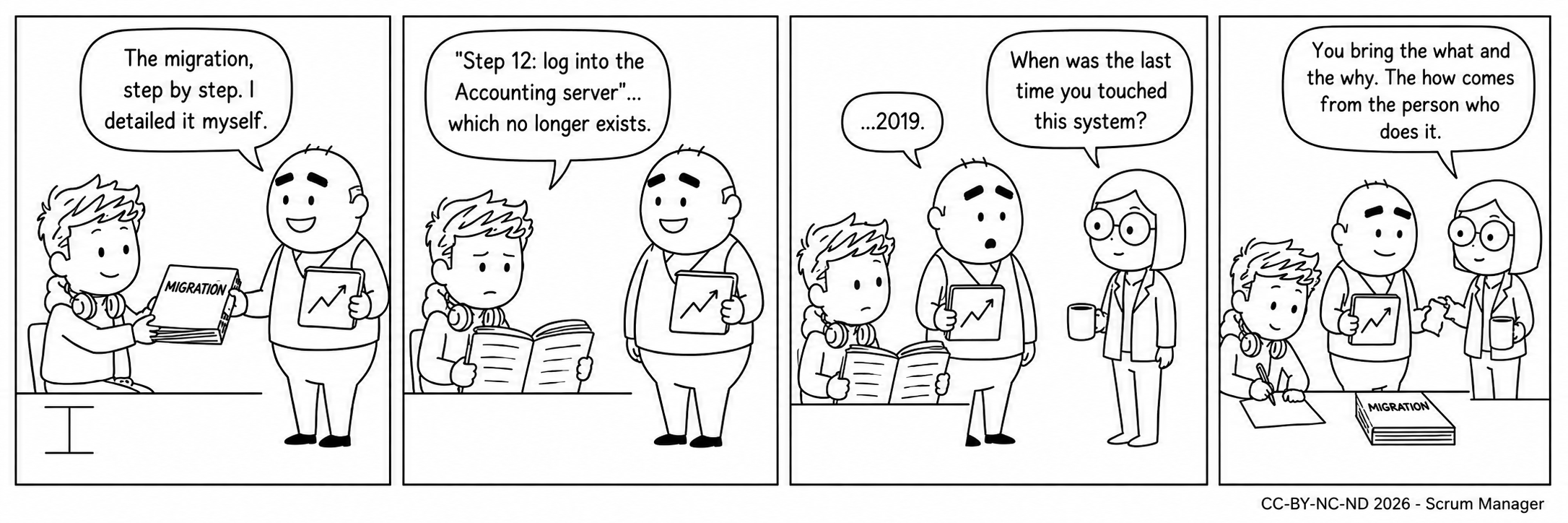
The Manifesto places individuals and their interaction above processes and tools, and Agile Bedrock reads this as an economic observation rather than romanticism: in knowledge work, the quality of the result depends more on people's tacit knowledge than on the quality of the processes. Such knowledge is personal and context-specific, and therefore hard to formalize and communicate: it does not fit into a procedure, however carefully that procedure is written. This is why self-managed teams remain the heart of agility, not because they need no direction, but because that direction must come from knowledge of the work rather than from hierarchy. When someone who does not do the work decides how it must be done, the capacity for local adaptation is lost. The split that works leaves the what and the why to whoever defines value, and the how to whoever has their hands on the system.
Want to keep pulling the thread? This topic unfolds in Agile Bedrock (v 1.1) > Foundations of empiricism > People, interaction and tacit knowledge.
We will send you every new strip when it is published.